 Pergolas
 My custom quote
 Confirm my order
 Our customer projects
 Our blog articles
 Installation guides
 Your testimonials
 CliKIT on TV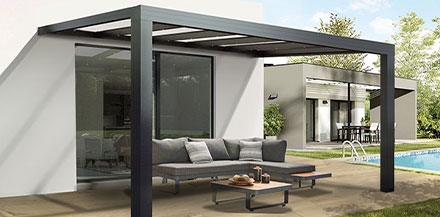

 Carports
 Our price guides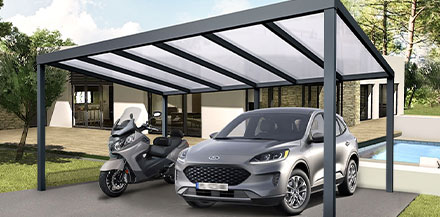
 Kit Verandas

 Entry Airlock



 Awnings & Covers
 Glass Curtains
 Skylight

 Who are we?
 Free delivery
 Secure payment
 My custom quote
 Confirm my order
 Our customer projects
 Our price guides
 Our blog articles
 Installation guides
 Your testimonials
 CliKIT on TV
What is a carport?
There is no escaping it! In house-building brochures or simply by paying attention to the structures present in the properties of friends and family, car shelters are taking up an increasingly important place around homes. It must be said that modern solutions offer perfect integration and that, in addition to an obvious aesthetic appeal, the practical side is constantly being highlighted.
Has the carport become essential?
Car shelters are therefore very popular at the moment, driven by the growing range of carports. And while purists of the French language tend to use the term "abri de voiture", the commercial entity most widely used remains very much the carport.
The covered structure comes in many forms and even in different materials, such as the aluminium carport more recently or the wooden carport in a more traditional way.
But what exactly is a carport? Is it taxable? What do you need to know about these sometimes modular structures that are full of advantages? As a specialist on the subject, CliKIT provides you with the complete guide to everything you need to know about carports.
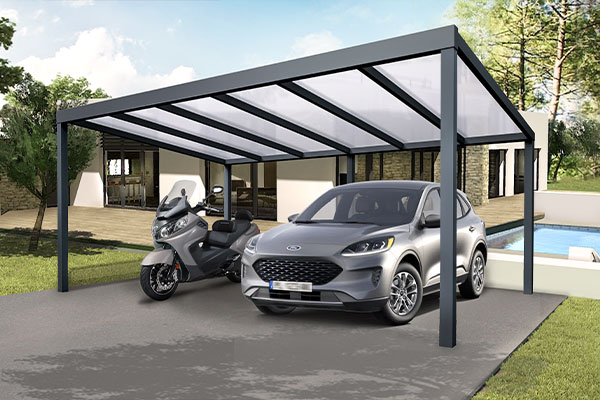
A carport: a practical and aesthetic car shelter structure
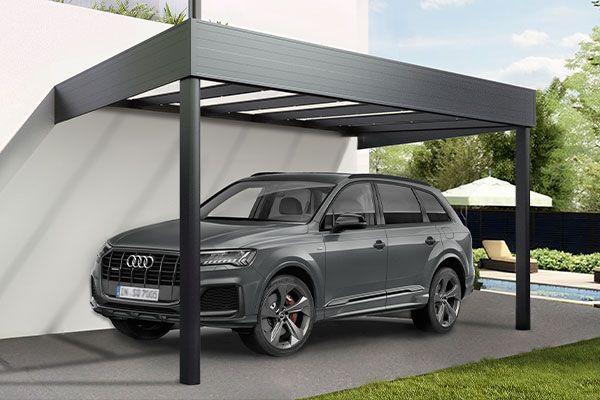
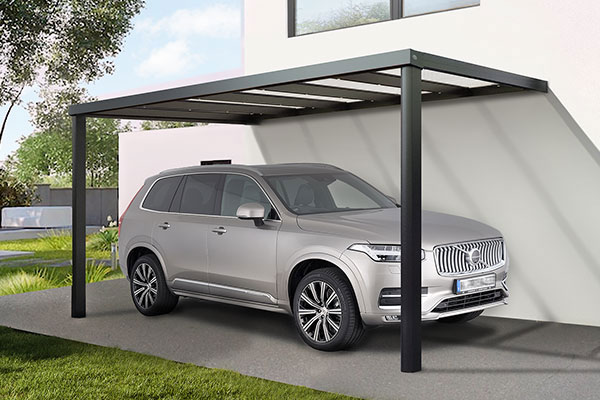
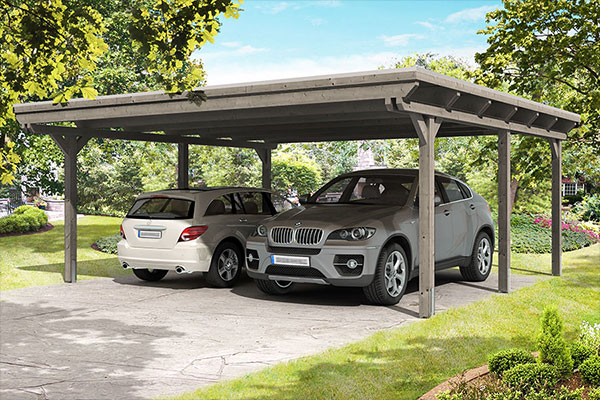
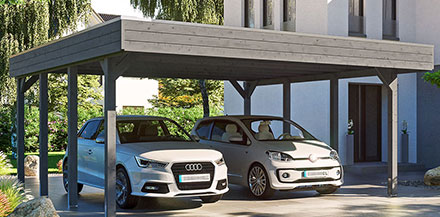
A covered structure available in both aluminium and wood, the carport offers an aspect that is as practical as it is aesthetic. Primarily intended to house a vehicle and protect it from the elements while providing a conventional parking space on the property, the carport has continued to evolve in recent years.
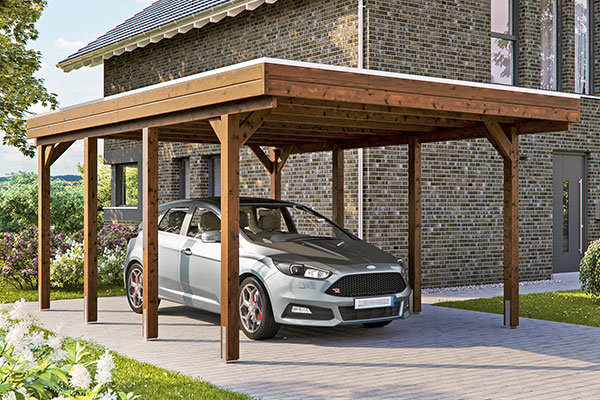
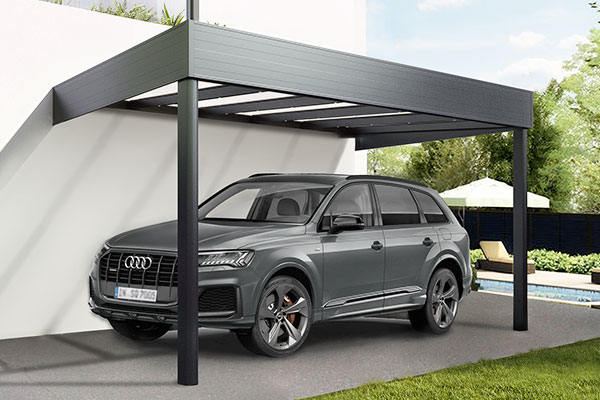
Available as a kit and made to measure for a perfect fit with CliKIT, and modular thanks to various accessories, the carport is now widely adopted. It offers premium protection for vehicles or stored items, while enhancing the exterior of a home, sometimes with a great deal of modernity. Wall-mounted or freestanding, this car shelter is far more accessible than a garage, both financially and administratively.
What is the difference between a pergola and a carport?
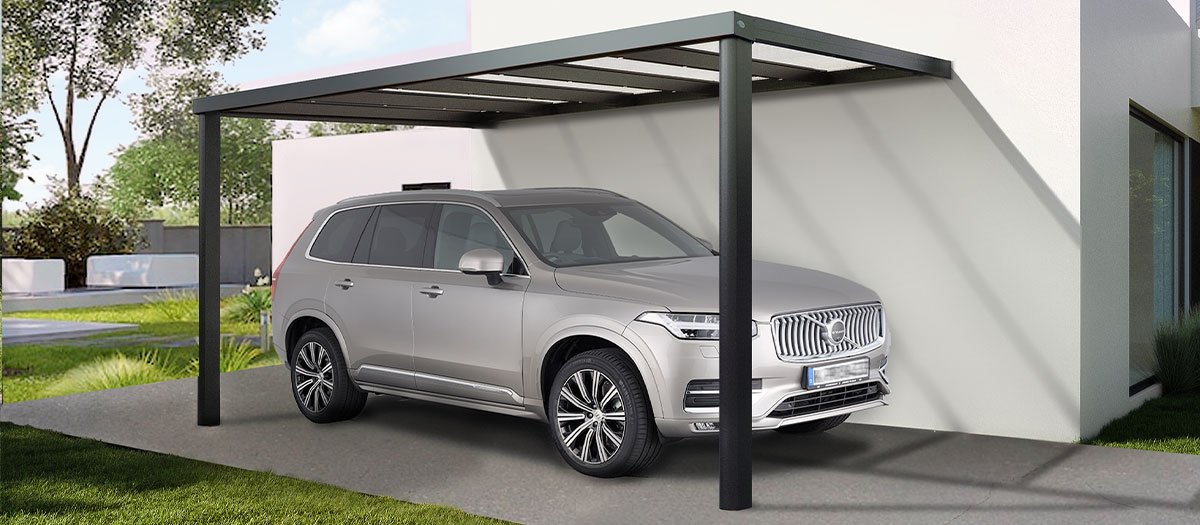
While a pergola is genuinely considered as a home extension, being able to be attached to walls or freestanding, a carport takes on a true shelter dimension, more intended for storage and parking of personal vehicles.
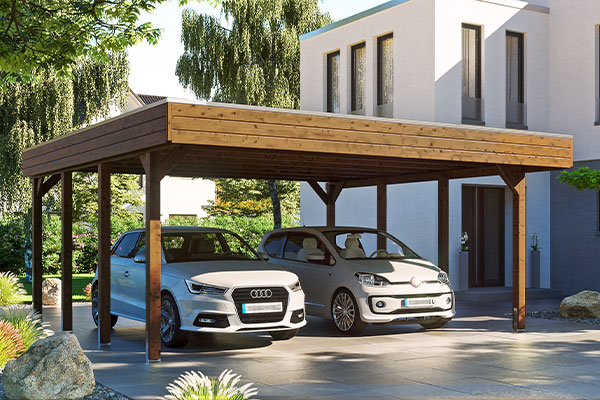
Depending on their size, carports can accommodate motorcycles, cars and even motorhomes, and they are also useful for storing outdoor items or even for sheltering from the sun and bad weather during days spent outside.
However, the pergola is far more versatile and focused on accommodating the home's residents, unquestionably representing a living space nestled between the indoors and outdoors. CliKIT's adaptability and its many kit accessories further enhance this aspect!
Furthermore, accessories can also be added to the brand's carports in order to customise your car shelter according to each need or each preference within your property.
Furthermore, there are several ambiguities between a pergola and a carport, particularly at the time of administrative declarations. We return to this point below.
What does the law say about carports?
Is a car shelter at home subject to a tax? Potentially considered as a home extension since it is a non-removable structure, a carport is subject to certain specificities in the eyes of the state. While people frequently wonder whether it is necessary to submit a building permit application for a carport, the answers are not always straightforward. Between declarations, taxes and levies, what does the law say about carports?
What does the law say about carports?
The declaration of a carport remains mandatory but the process is particularly straightforward, as CliKIT has already explained in its dedicated guide.
Is a carport taxable?
Although the development tax exempts terraces and pergolas, it remains very much present in France for carports. These are taxable and subject to taxation. Generally, rates do not exceed 3% in rural areas and vary depending on the municipality and department where the property is located.
Furthermore, a carport tends to increase the property tax based on its surface area. Tax calculations are made using the Cerfa 6650 form, which must be sent to the tax authorities within 90 days of the completion of the works.
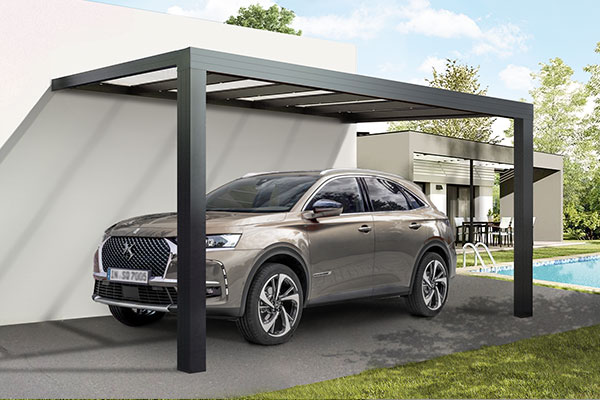
Building permit for a carport: from how many m²?
Considered a construction and extension in the same way as a pergola or a winter garden, a carport requires certain administrative obligations at the time of its installation. And this applies whether it is a kit version or not! It is possible to install a carport without authorisation, provided it has a footprint of less than 5 m².
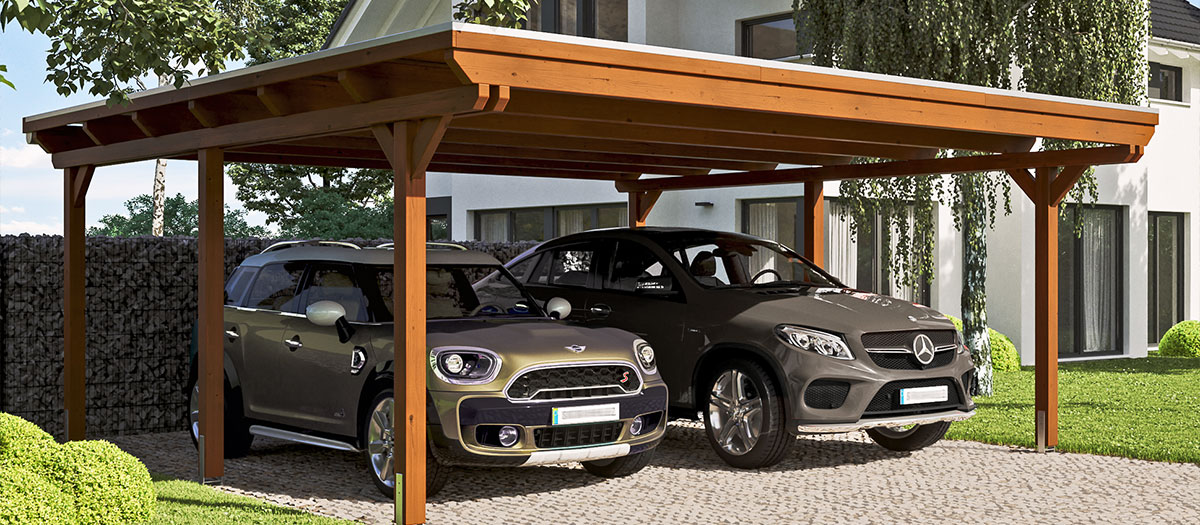
However, such a surface area is rather rare, which is why a carport or pergola structure with a footprint of between 5 and 40 m² requires the completion of a prior declaration of works application. Beyond this, a building permit application may be required.
It is always advisable to check with your local town hall to ensure you are following the correct procedures and thus avoid any unpleasant surprises. Sometimes, the opposite effect is observed, as certain municipalities tend to increase the permitted surface area before a building permit is required.
Share this content

 View profile