 Pergolas
 My custom quote
 Confirm my order
 Our customer projects
 Our blog articles
 Installation guides
 Your testimonials
 CliKIT on TV
 Carports
 Our price guides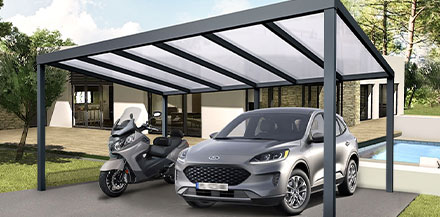
 Kit Verandas

 Entry Airlock


 Awnings & Covers
 Glass Curtains
 Skylight
 Who are we?
 Free delivery
 Secure payment
 My custom quote
 Confirm my order
 Our customer projects
 Our price guides
 Our blog articles
 Installation guides
 Your testimonials
 CliKIT on TV
Do you need to declare a carport?
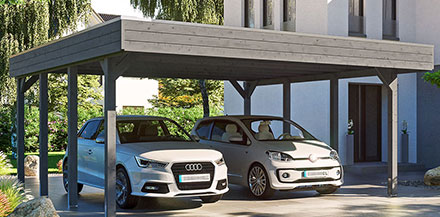
Homeowners continue to turn to carports to park their car or simply to add a new outdoor storage space to their property. For several years now, constructions of this type have therefore become established at many properties, and thanks to the arrival of new players in this growing market, it has seemingly never been easier to install a kit carport for your car.
First and foremost...
With an aluminium carport or a more traditional but equally practical structure such as a wooden carport, there are still a few aspects to take into account — particularly those relating to legal requirements!
Indeed, when installing a carport, one must consider whether a building permit is required. It is above all a structure added to the exterior, and for any construction of this type, the question is legitimate.
However, it does not stop there, as it also seems important to consider a potential declaration to the tax authorities. No need to panic — CliKIT gives you guidance on whether or not a carport needs to be declared, in full compliance with the law.
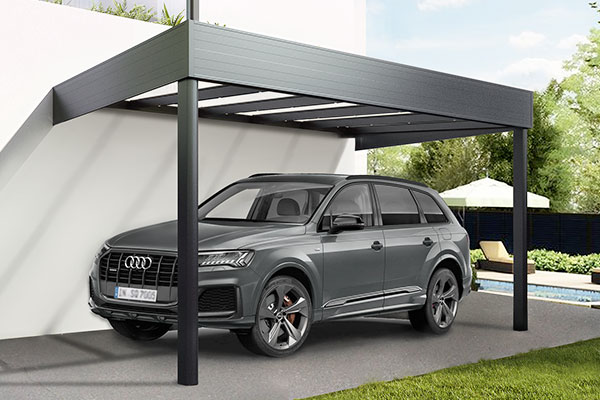
What is the difference between a lean-to and a self-supporting carport for your project?
Although a planning permission application is always mandatory when installing a carport, a pergola or any other structure of this type, the regulations nonetheless vary depending on whether or not the structure is connected to your home.
Indeed, the requirements are not the same depending on whether your structure is attached to your property or simply erected on a slab or independently within your land.
When a carport is attached directly to the house and there is a physical connection between the two, such as a door, it constitutes an extension of the dwelling's floor area. You should then check whether your property is located within an urban zone covered by a local urban plan (PLU) or a land use plan.
In the case of a self-supporting carport or one independent from the main dwelling, the constraints are generally fewer.
All these nuances depend on the Urban Planning Code, which should be consulted in the event of any questions at any stage of your project and works.
Do you need to declare your carport to the tax authorities?
For tax purposes, the answer is always the same and nothing really changes whether it concerns an extension of the living area, the creation of an annex or an independent structure on the property's land. A simple declaration to the tax authorities may or may not be required after the work depending on your municipality; we therefore recommend that you check with your Urban Planning Department.
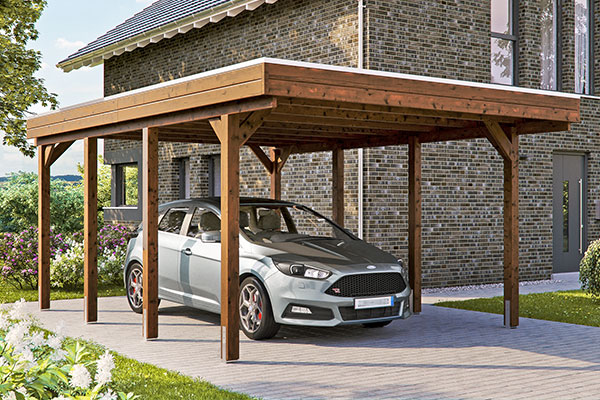
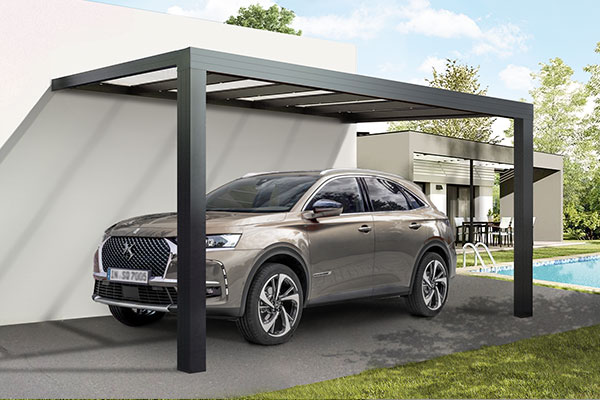
Indeed, carport or even pergola constructions always represent an extension within the property, whether or not they are considered living spaces. As a result, the rate used to calculate property tax changes. Previously, the same applied to the housing tax, but since its abolition, only the property tax is concerned in this aspect relating to the urban planning rules specific to each municipality.
Please note that if this declaration is required of you, you must declare this new floor area within 90 days following the completion of the work at your property. For your car shelter or custom carport, such a declaration may in some cases entitle you to a property tax exemption for one or two years.
From what floor area is a building permit required in your municipality for a car shelter?
Whether we are talking about a carport or a pergola, as is often the case, the construction permit depends mainly on the ground footprint of the structure. Unless located in a protected zone, it is possible to build your structure without a declaration if it is under 5m² of ground area.
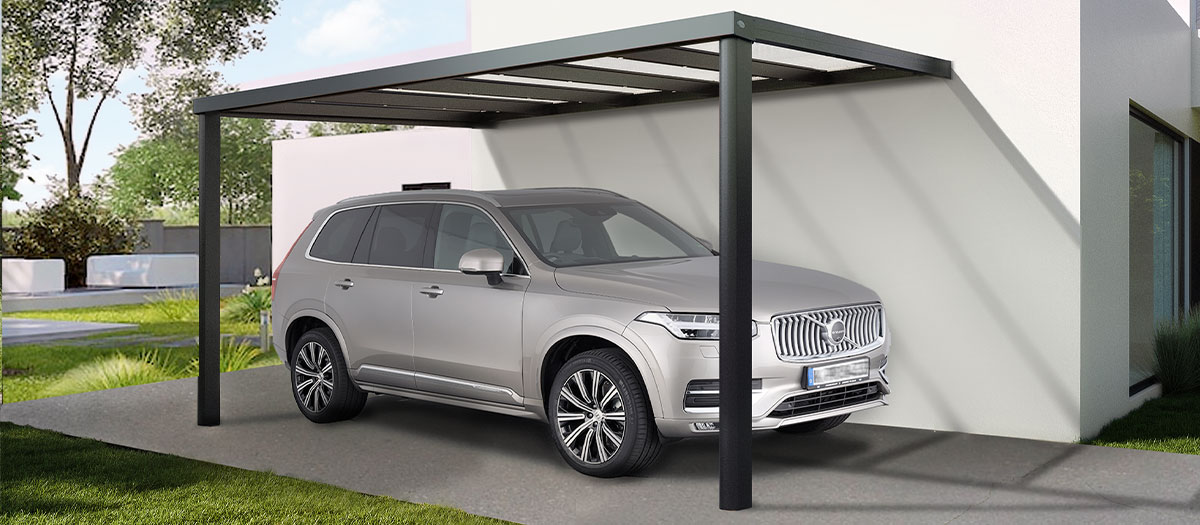
From 5m² to 20m², only a prior declaration of works at the town hall will be required, and beyond that, a building permit will become absolutely necessary. However, a prior declaration will suffice up to 40m² if the structure is attached to part of your property. Generally, this aspect can be advantageous and allows large constructions to avoid needing a building permit application.
In any case, the best reflex is to enquire directly with the relevant town hall services in order to avoid mistakes and above all, to erect your structure in full compliance with the law. Your municipality will be able to guide you through your construction project and also provide you with the relevant forms depending on your project's requirements.
Is the declaration process the same for an aluminium carport and a wooden carport?
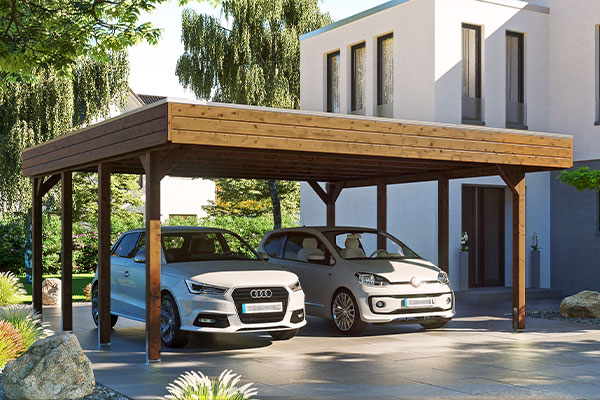
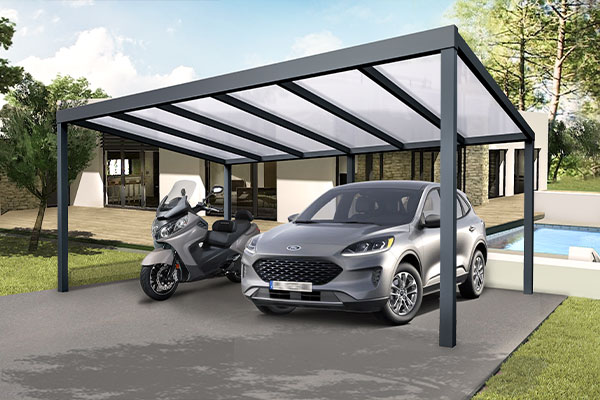
Today, carports are clearly very popular among homeowners. It must be said that their advantages are numerous and that the aesthetic aspect is also frequently highlighted by convinced users.
On this subject, the possibilities can be numerous, with sometimes wooden structures or aluminium structures, but above all, operating methods that differ. Indeed, CliKIT has for example become the specialist in kit structures to allow all homeowners to benefit from the construction of their choice with great advantages.
It is however essential to understand that the type of materials or the shape of the structure in no way changes the declaration requirements. For tax purposes or for the town hall of your municipality when a building permit is required, only the final floor area should count in the calculation. There is therefore no difference in the declaration required between wood and aluminium.
Share this content

 View profile