 Pergolas
 My custom quote
 Confirm my order
 Our customer projects
 Our blog articles
 Installation guides
 Your testimonials
 CliKIT on TV
 Carports
 Our price guides
 Kit Verandas
 Entry Airlock



 Awnings & Covers
 Glass Curtains
 Skylight
 Who are we?
 Free delivery
 Secure payment
 My custom quote
 Confirm my order
 Our customer projects
 Our price guides
 Our blog articles
 Installation guides
 Your testimonials
 CliKIT on TV
Qu'est-ce qu'une loggia ? Différences, atouts et fermeture
A loggia is a covered space recessed into a building’s facade, forming a natural transition between indoors and outdoors. Its construction sets it apart from a balcony, terrace or sunroom. With clear benefits and a variety of ways to adapt it to individual preferences, the loggia is popular in new builds and renovations alike. Here’s a closer look at this structure and how it differs from other spaces, particularly balconies and sunrooms.
What is a loggia?
Unlike a terrace attached to the outside of a building or a sunroom with its own roof, a loggia is an outdoor space that extends from the home but sits beneath the building’s structure.
In most cases, the floor above serves as a roof. That is why a loggia is not a balcony: it is recessed into the building rather than projecting outward.
This is not always the case, but for obvious safety reasons, an elevated loggia has side walls.
A loggia is accessed from inside the apartment or house, but it can take many forms: it might open off a living room or extend from a bedroom. Either way, it adds a distinctive touch to the home.

Loggia, balcony, terrace or sunroom: what’s the difference?
| Structure | Position | Covered | Integrated into the building | Use |
|---|---|---|---|---|
| Loggia | Recessed | Yes | Yes | Sheltered outdoor space |
| Balcony | Projecting outward | Not necessarily | Attached to the facade | Open outdoor space |
| Terrace | At ground level or above | Not necessarily | Extension of the building | Room |
Loggia or balcony: what sets them apart
The main difference between a loggia and a balcony is their position relative to the building’s facade. A loggia can blend so seamlessly into the overall structure that it is barely noticeable, unlike a balcony, which projects outward from the wall.
Compared with a balcony, a loggia often provides better protection from wind and bad weather. This gives you more options for furnishing and using the space.

Loggia or terrace: two spaces not to confuse
It is understandable to confuse a loggia with a balcony, but a terrace is quite different. Although a terrace is generally larger than a loggia, it is not integrated into the building’s structure unless it is a "rooftop" terrace.


Loggia or sunroom: integrated space or addition?
A loggia and a sunroom serve different purposes. A sunroom is an addition to the existing habitable space that expands the interior. Even when enclosed, a loggia is not designed to provide the same level of insulation as a sunroom.
Loggia or winter garden: how is each used?
A winter garden is rarely integrated into a house or apartment building; instead, it is generally designed as a separate space. A loggia, by contrast, is an extension of the living space that brings the outdoors into the home.
What are the advantages and limitations of a loggia?
Although it is not completely open to the outdoors, a loggia brings indoor and outdoor living together. Here are its main advantages and disadvantages.
Everyday benefits of a loggia
A loggia is a distinctive space within a home. It offers many advantages:
- Protection from the elements
- More versatile than a balcony
- Use as additional space
- More privacy than a balcony.
Drawbacks to consider
As always, advantages can come with drawbacks. A loggia is no exception:
- Less natural light, depending on its orientation
- Less of an outdoor feel during the warmer months
- Heat can build up inside it in summer.

Does a loggia count toward habitable floor area?
Under the French Construction and Housing Code, an open loggia is not included in the habitable floor area. It may, however, be included if it is fully enclosed. In addition, under France’s Carrez Law, any area with a ceiling height of less than 1.80 meters is not considered habitable floor area.
Can you enclose a loggia?
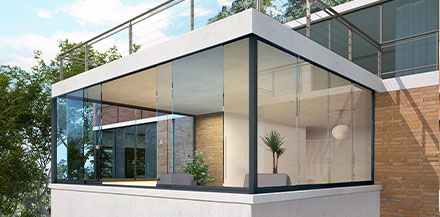
You can enclose a loggia to give it even more character and make it more versatile. Using the same principle as its glass curtain systems for outdoor structures, CliKIT offers custom-made loggia and balcony enclosures.
These enclosures are designed to be sturdy and durable while remaining lightweight and easy to install. They are also designed to be economical and environmentally friendly, while staying transparent so you can enjoy plenty of natural light.
Thanks to a modular system, you can open or close your loggia to suit your needs and the season, making it comfortable whatever the weather.

Frequently asked questions
Share this content

 View profile