 Pergolas
 My custom quote
 Confirm my order
 Our customer projects
 Our blog articles
 Installation guides
 Your testimonials
 CliKIT on TV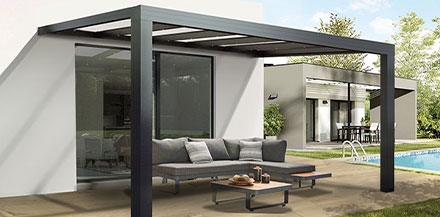
 Carports
 Our price guides
 Kit Verandas

 Entry Airlock

 Awnings & Covers
 Glass Curtains
 Skylight
 Who are we?
 Free delivery
 Secure payment
 My custom quote
 Confirm my order
 Our customer projects
 Our price guides
 Our blog articles
 Installation guides
 Your testimonials
 CliKIT on TV
Installing a Pergola Without a Permit: Guide to the Rules to Follow
Permitted or not? As with any addition of a structure to the exterior of your home, there are several rules to follow to ensure that the installation is legal. Regarding the pergola, is it possible to install one without a permit? Subtleties and clarifications are on the agenda to help you perfectly plan the installation of your pergola with CliKIT.
What is a pergola without a permit?
French law is very clear regarding outdoor constructions and therefore pergolas installed without a permit. Nevertheless, this clarity is beneficial as it allows the owner to easily know in advance whether or not certain administrative conditions must be met. But is it truly possible to build or install a pergola without a permit?
In the majority of cases, a declaration at the town hall remains necessary, as the addition of posts and a roof will change the appearance of the house or facade. This applies whether the pergola is wall-mounted or freestanding. Interestingly, however, an area of less than 5m² fully exempts you from any declaration or prior permit, provided the structure does not exceed 12 metres in height. We return to this in more detail below.
Definition and distinction from other structures
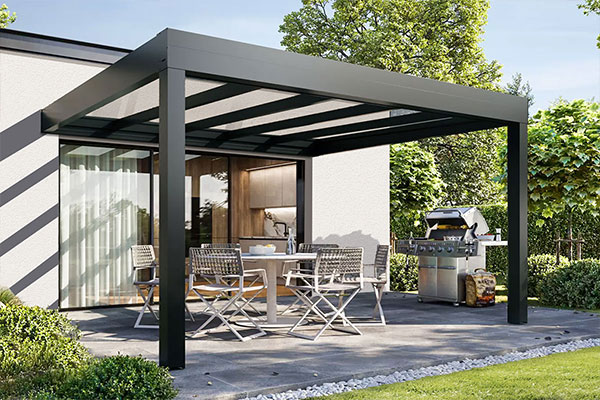
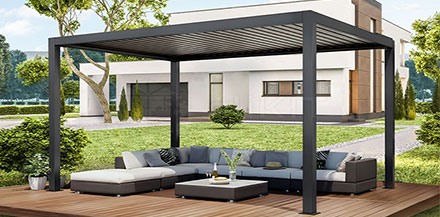
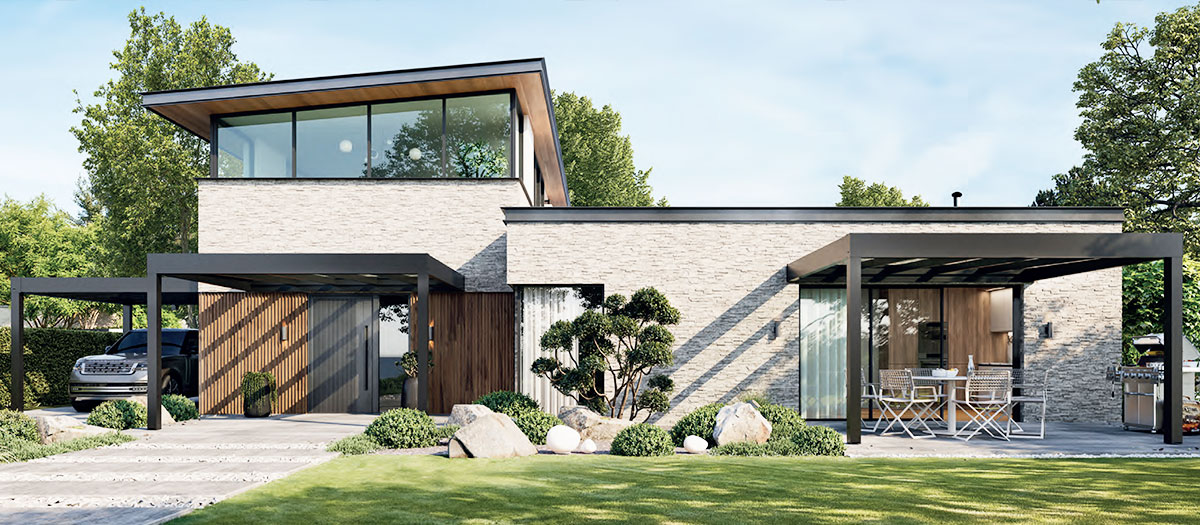
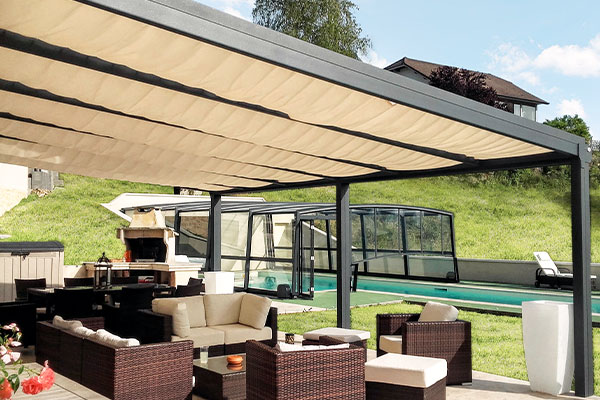
A pergola is a freestanding or wall-mounted outdoor structure that provides shelter from the elements while maintaining one or more openings to the outside. It does not extend the living area of the home, and this is one of the main differences between a pergola and a conservatory.
Unlike a gazebo, it remains considerably more rigid and timeless, while allowing for great moments within it depending on the layouts created and accessories added. Further proof of rare versatility, with the added bonus of flexible legislation for owners when installing a pergola without a permit or with only a declaration.
What are the factors that influence the rules?
Taking into account the chosen or planned location, the ground area of the pergola to be installed, as well as the height and type of structure, many factors come into play in the declaration equation.
One can also add the geographical location as well as the materials used on the pergola to understand that a case-by-case approach tends to prevail.

As you will have understood, the rules are precise, but several factors can influence and modify this established order. The advice is therefore always the same: familiarise yourself with the legislation but also with local constraints by visiting the town hall.
What steps should you take depending on the area of your pergola?
Building permit, prior declaration at the town hall, or permit application: the procedures differ depending on several criteria. French law is precise on the subject, and when carrying out the steps for the declaration of your pergola, it is essential to plan ahead and know its area. Indeed, three types of area are distinguished, which may or may not impose certain administrative requirements.
Area under 5 m²
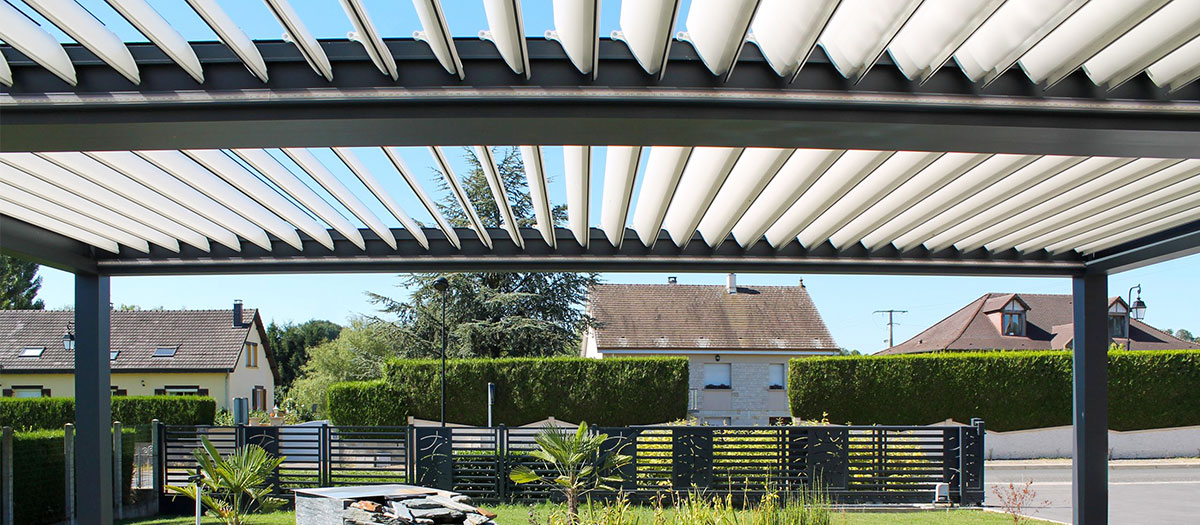
Relatively small, a pergola with a ground area of less than 5m² can be a very practical choice and provide sufficient comfort for many households. This condition applies to all types of outdoor constructions to avoid having to apply for a building permit, but the height must never exceed 12 metres.
This figure is very rarely exceeded, and it is for this reason that a pergola with an area of less than 5m² is attractive. Whether freestanding or wall-mounted, a pergola that does not exceed this area requires no permit or even any prior declaration.
Area between 5 and 20 m²
We are entering a range that is well known to property owners. A large proportion of pergola areas fall within these dimensions. With a standard build or a made-to-measure build such as those offered by CliKIT, pergolas frequently adapt to existing terraces that cover these surfaces.
The standard choice is by no means restrictive! To enjoy this already generous space with your future aluminium pergola, only a prior declaration of works at the town hall is required. On the positive side, this is completely free of charge but must be planned in advance, since as its name indicates, it is a declaration to be made beforehand. The town hall of your local municipality will be able to guide you with any questions and ensure that you are within your rights when installing this future extension.
Area over 20 m²
With a pergola covering more than 20m², we inevitably enter a different dimension with its share of constraints and obligations. A pergola of this size clearly changes the visual appearance of the facade and becomes an imposing structure.
A building permit is then required if the footprint exceeds this total area. The threshold is nonetheless generous, with an area that can, on the same basis, reach up to 40m² in the urbanised zones of certain municipalities.
Once again, the town hall will be able to advise and guide you through the steps required for your pergola. The project must leave no room for doubt, and in order to anticipate whether a building permit or a prior declaration of works is required, you must ensure you comply with the regulations and, above all, know the area of your pergola.
With CliKIT, no worries on this matter: our kit and made-to-measure offer gives you the exact area of the planned extension.
What outdoor improvements can be made without requiring a permit?
In certain cases, several outdoor improvements can be made without any declaration or even any application. This applies to pergolas, as they benefit from adapted regulations. Naturally less complex than a garage or a solid construction, a pergola can be installed in the blink of an eye and even without any administrative constraints. This concerns two well-defined cases that we outline below.
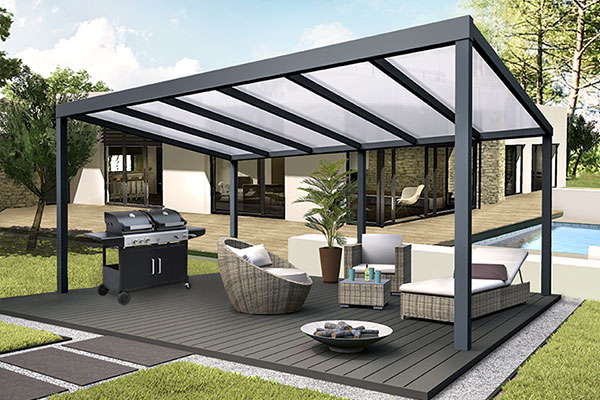
The freestanding pergola
Within the CliKIT catalogue or elsewhere, you will notice that there are two types of structures among permanent pergolas. We are not talking about the difference between an aluminium pergola and a bioclimatic pergola, but rather the distinction between a wall-mounted pergola and a freestanding pergola.
This is also referred to as a freestanding pergola, and this option is an undeniable advantage for those who want as few constraints as possible.
This structure can be installed anywhere on the property with the only requirement being that all four posts and foundations are fixed in the ground. And as mentioned above, a freestanding pergola of less than 5m² requires no declaration.
The demountable pergola
This type of pergola has a particular advantage: a demountable pergola can be installed without prior permission from the relevant town hall. When the structure is installed for less than three months, no administrative steps are required.
Regulations for protected areas
It may happen that heritage protection measures or other local actions change the rules regarding a pergola that would ordinarily require no permit or declaration. This is why a visit to the town hall, to remove any doubt, is often a sensible precaution.
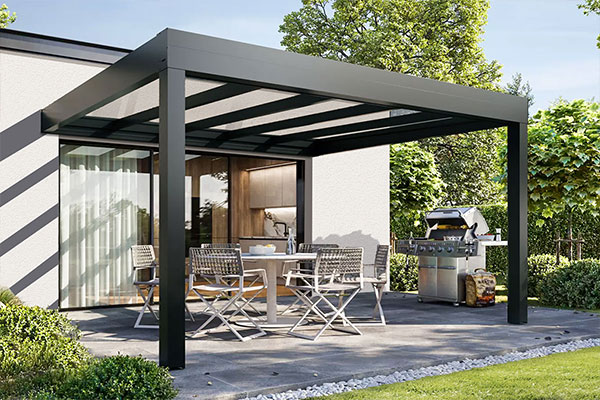
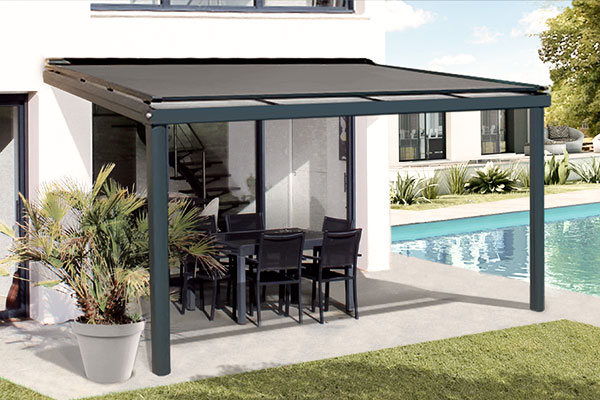
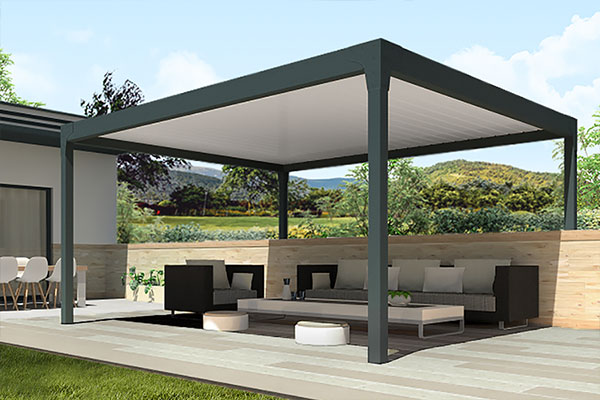
Yes, there is indeed a regulation for protected areas when installing a pergola without a permit. This depends on local urban planning rules, whose purpose is to protect the historical, cultural and architectural heritage of the area where the property is located.
It is in this specific case that a pergola with an area of less than 5m² may nonetheless require a prior declaration of works. The same applies to a demountable pergola which cannot, for example, remain in place for more than 15 days when a listed historic monument or remarkable site is adjacent.
Some practical tips for a successful project
Knowing how to choose your pergola is one thing; completing your project without complications is another. As discussed throughout this guide on installing a pergola without a permit.
do not hesitate to visit the town hall to consult the Local Urban Development Plan (PLU) and above all, to speak with the relevant staff who will be able to help you carry out your project, including by reminding you of the administrative requirements related to the installation of a pergola.
Other professionals, such as those on the CliKIT team, are also a valuable resource throughout your project. From the initial desire for an extension to the last pergola accessory added, the customer service team will be delighted to support you as best as possible.
Share this content

 View profile