 Pergolas
 My custom quote
 Confirm my order
 Our customer projects
 Our blog articles
 Installation guides
 Your testimonials
 CliKIT on TV

 Carports
 Our price guides
 Kit Verandas

 Entry Airlock



 Awnings & Covers
 Glass Curtains
 Skylight
 Who are we?
 Free delivery
 Secure payment
 My custom quote
 Confirm my order
 Our customer projects
 Our price guides
 Our blog articles
 Installation guides
 Your testimonials
 CliKIT on TV
Pergola declaration: is it necessary?
With more and more pergolas being installed in France, the advantages of this structure are becoming increasingly well known. The benefit of enjoying an additional outdoor space is permanent, with notably the possibility of modifying this space to your liking and according to the use you wish to make of it throughout the year.
Indeed, a pergola is in no way subject to a planning tax but may, however, be subject to property tax.
First of all...
Between work declarations, the presence or absence of a terrace, its size, or the declarations to be made to the tax authorities, what are the things to know before ordering a pergola?
In all cases, it is important to understand that a pergola is considered by the French State to be a permanent installation and that the characteristics and surface areas discussed must be known in order to carry out the necessary procedures properly. Depending on the changes made, certain steps may therefore become mandatory in the eyes of the law.
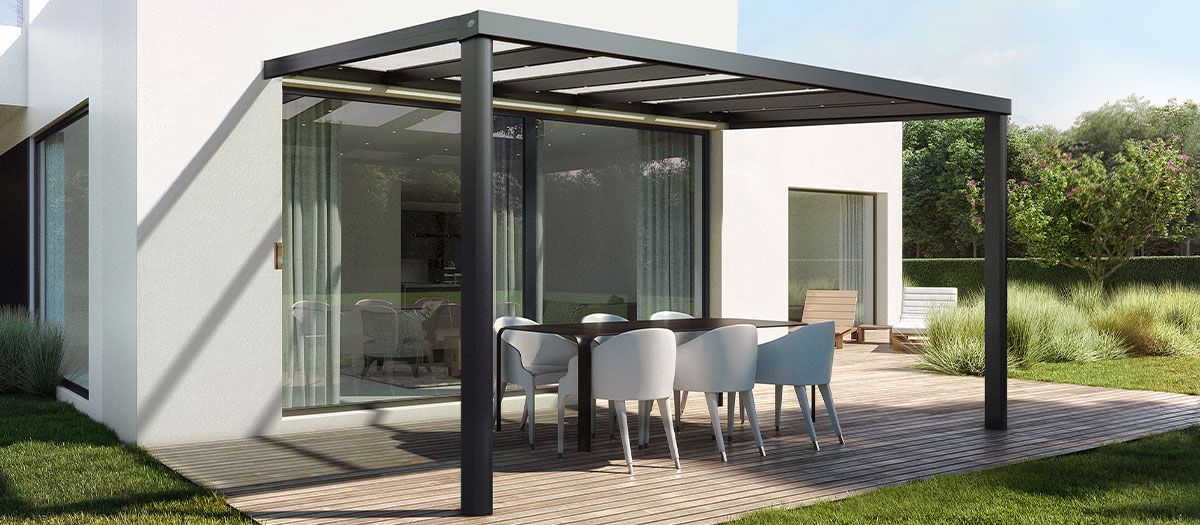
No declaration obligation: in which cases?
Except for certain specific rules related to protected zones, a small construction installed directly in the outdoor space of the property does not require a declaration, provided two conditions are not exceeded:
- 12m in height
- 5m² of floor area including the ground footprint.
If either of these two dimensions were to be exceeded, it would then be necessary to apply for planning permission directly from your local authority. You can then either submit a prior declaration of works or apply for a planning permit depending on each case. Which cases?
When is a planning permit mandatory for a pergola?
One of the advantages of the pergola is that it very rarely requires the submission of a planning permit application to the local authority.
As always, it is advisable to enquire directly with the urban planning department of the relevant local authority in order to avoid any unpleasant surprises at the time of a potential inspection.
If the structure does not exceed 20 square metres, no prior declaration is required for a pergola. This applies to all types of pergola, such as the rigid-roof pergola or the bioclimatic pergola. However, there is a factor to take into account if the pergola's surface area falls between 20 and 40 square metres.

If the total surface area of the construction comes to exceed 150 square metres with the addition of this pergola, then a declaration and a planning permit are required in that case. Generally, there is a tendency to build or make use of an existing terrace to install a pergola. On this subject, there are also a few criteria to take into account regarding its declaration.
Building and declaring a terrace for the installation of a pergola
A pergola can be installed at any level of the house and generally above almost any surface. However, it is very common to place a pergola above a terrace, for example to enjoy a poolside area or long outdoor lunches under this structure.
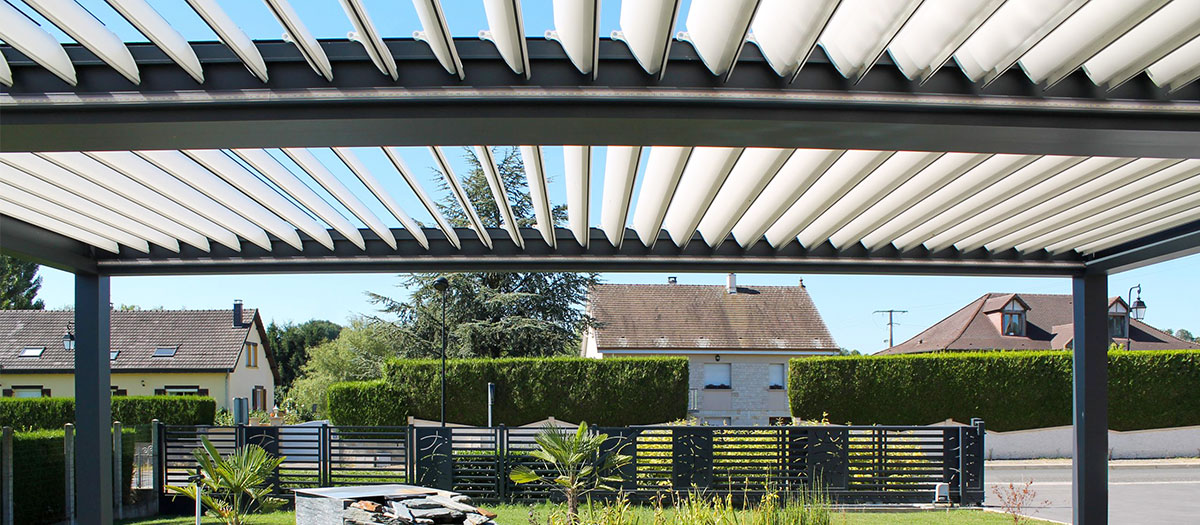
What does the law say regarding the declaration of a terrace?
First and foremost, it should be noted that the law is not always entirely clear when it comes to terrace declarations. It must therefore be taken into account that the construction of a terrace on an existing roof or canopy requires no authorisation request.
Furthermore, a ground-level terrace does not require a declaration at the local authority or a planning permit application either. A terrace is considered to fall into this specific category if it does not exceed 60 centimetres of elevation above the existing ground level.
In other cases, a terrace with a surface area of between 5 and 20 square metres requires a prior declaration to be submitted before work begins. Beyond this surface area, a planning permit application becomes mandatory.
As mentioned above, it is essential to enquire directly with your local authority to find out whether any additional specific conditions apply within your municipality.
Is a pergola subject to taxation?
Once again, the pergola has a key advantage over a traditional veranda, including in terms of taxation.
Indeed, a pergola is in no way subject to a planning development tax but may, however, be subject to property tax.
Since it is a structure that enhances the property and adds value and charm to it, this change — generally negligible — is usually nothing to worry about.
Share this content

 View profile