 Pergolas
 My custom quote
 Confirm my order
 Our customer projects
 Our blog articles
 Installation guides
 Your testimonials
 CliKIT on TV
 Carports
 Our price guides
 Kit Verandas

 Entry Airlock

 Awnings & Covers
 Glass Curtains
 Skylight
 Who are we?
 Free delivery
 Secure payment
 My custom quote
 Confirm my order
 Our customer projects
 Our price guides
 Our blog articles
 Installation guides
 Your testimonials
 CliKIT on TV
Building your solar pergola: our practical guide
Investing in a pergola is always a relevant choice. The benefits for your property and home are appealing, as are the energy savings made when taking advantage of sunny conditions. In this sense, the appeal is perhaps even greater when you want to harness the power of nature to produce electricity, particularly through a solar pergola equipped with photovoltaic panels.
Choosing a solar pergola
Between the construction, the setup and the choices made in advance regarding models, location and the different types of pergola to select, the decision is nonetheless not one to be made on a whim.
It is always worthwhile exploring the subject in advance and, whether investing in a solar pergola with photovoltaic panels is a real short-term objective or not, CliKIT guides you, as a true specialist on the subject, on everything you need to know. From building a solar pergola to managing the electricity produced by the photovoltaic panels on the shelter, it is time to take the plunge towards modernism and efficiency.
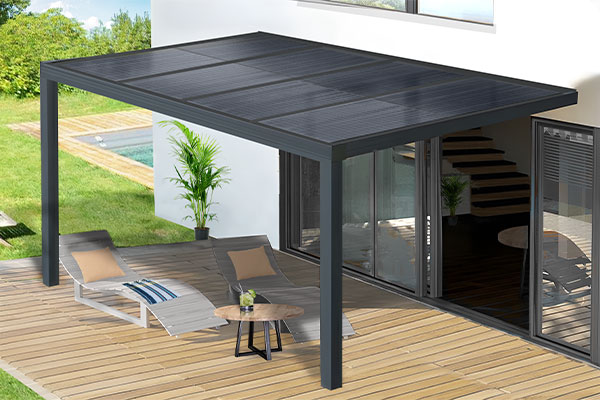
How do you build a solar pergola?
Generally, the process to follow is relatively straightforward, especially when you choose to install a pergola yourself. It goes without saying that the aluminium pergola is the most suitable for accommodating solar panels directly on its structure, for obvious reasons of ease of installation and durability. Its maintenance is far easier and its resistance is greater than all other materials used by certain pergola manufacturers and other shelters designed for homes.
Historically, a manufacturer like CliKIT has become a master in the field, producing and offering made-to-measure pergolas with easy, self-assembly installation. Always keeping this principle in mind, CliKIT will now offer the integration of photovoltaic panels to add yet another advantage to such a structure. A solar pergola will have obvious benefits that we will cover throughout this guide, both in terms of electricity consumption and the creation of a new space perfectly nestled between the inside and outside of the home.
While also having to accommodate the installation of a certain number of photovoltaic panels whose dimensions are mostly standard, there are certain things to take into account when building a solar pergola. For example, the slope of the roof can play a major role in capturing and producing electricity.
Correctly angling your photovoltaic panels when building a solar pergola
Why are most solar panels positioned at an angle when you look at those famous photovoltaic fields? The same logic applies to a rooftop, and unless the roof is flat, the reasoning is clear. Indeed, to produce electricity in the most efficient way possible, a solar panel must be fixed at a certain angle. This angle has a significant impact on future electricity production.
This makes it possible to adapt to the different heights of the sun throughout the year as seasons and daylight hours change. Unless you opt for frequent angle adjustments — which is obviously not recommended for a solar pergola or any other structure that hosts such electricity production using the sun and a photovoltaic panel — the best installation angle is 30°. This should be kept in mind when fixing the solar panels to your pergola's roof, which is already sloped to efficiently drain water and other particles. Furthermore, this inclination tends to facilitate the cleaning of the pergola or the entire structure.
What grants are available for a solar pergola?
The installation of a solar pergola is most often done solely for its economic and energy benefits. It is true that placing solar panels on the roof of the structure directly obstructs the open view and the natural light entering the space. The trade-offs must therefore, by this logic, be significant. And as is often the case, they are financial.
In order to encourage sustainable energy production, the French government has introduced various grants for the installation of solar panels, including on compatible pergolas. The same applies to certain local authorities, on a case-by-case basis. It is advisable to enquire at your local town hall to find out about the existence of such financial assistance for property owners.
The investment is therefore greater than with a standard pergola, but thanks to the production of so-called green energy, you can recoup the cost of such an installation more quickly. The self-consumption grant is unquestionably the best-known incentive and it is the one that attracts the majority of solar pergola owners.
Taking advantage of the self-consumption grant with your solar pergola
Since 2017, the French government has introduced a grant linked to output, delivered on a degressive basis to encourage households to equip themselves with solar panels. However, several criteria must be met in order to benefit from this with your solar pergola:
- The panels must be installed by an RGE-certified professional
- The output must be less than 100 kWp
- The pergola must self-consume with resale of the surplus kWp transferred as kWh.
As you will have understood from this last point, it is not possible to solely self-consume from your installation if you wish to benefit from this grant. To be eligible, you must sell energy as well.
Complying with the mandatory purchase obligation for panels on your solar pergola
Without direct grants, the owner can, depending on their resale contract and above all their production level, plan to sell the bulk of the electrical output in order to benefit from a faster return on investment than anticipated.
It is of course necessary to make the full investment upfront to get started, but very quickly, the first returns begin to come in.
This approach is very popular, particularly for its financial benefits. Why? The owner of a solar pergola can sell the energy and thus inject it into the national grid. EDF is obliged to purchase this energy, most of the time at a rate higher than the market price. Once this rate is agreed upon, it remains the same for 20 years, regardless of the evolving market price in France. For a solar pergola equipped with photovoltaic panels, it is therefore worth highlighting that the return on investment represents a very high potential, always depending on the kWp of each photovoltaic installation.
The multiplied benefits of a pergola with the installation of a solar pergola
Does one still need to describe all the benefits of installing a pergola at home? More and more households are choosing, without the slightest regret, to add this structure to their property. With countless installation possibilities, whether freestanding or wall-mounted, a pergola systematically brings a new energy to the home. Between indoors and outdoors, with a new way of enjoying your exterior space or thanks to all the customisation possibilities when you want to light a pergola or personalise it to your wishes and needs, it creates a magical world around the house.
Today, life in a pergola can be exhilarating at any time of year, thanks in particular to the benefits of bioclimatic pergolas which, as their name suggests, adapt to all conditions. The use of aluminium is obviously an additional asset that provides equally impressive durability and resistance.
To top it all off, the ability to install solar panels offers yet another advantage to pergolas. Always with the idea of being able to model them to measure for a kit-based, self-assembly installation, CliKIT's pergolas perfectly align with current energy and societal needs. The benefits are multiplied, always creating a "wow" effect among all your guests, family and friends visiting your home.
One sometimes wonders whether such an installation is possible on wood or other types of pergolas. It is certainly still common to find wooden pergolas, but in terms of energy and the potential installation for capturing sunlight and producing electricity, such a structure is far less practical. It is in fact almost impossible in most cases, with electrical installations being unsuitable for wood for obvious safety reasons.
How can I save money on my solar pergola?
The investment in a pergola is often substantial but it is, most of the time, easily offset by the comfort gained and the electricity bill that continues to fall. This is equally true when you own a solar pergola or a bioclimatic pergola enclosed with various CliKIT accessories and offering clear natural light.
However, when it comes to the solar pergola and its well-known photovoltaic panels on its roof, it is possible to make savings very quickly. This is particularly the case with the aforementioned government grants, but also thanks to certain strategies that are always welcome when you want to take the plunge and enjoy all the benefits of pergolas.
For example, it is often recommended to start your photovoltaic installation with a low output. Profitability is achieved more quickly with the assurance of consuming the production established on the roof of your pergola. Adding solar panels is very easy thanks to standard sizes and a pre-established installation on solar pergolas: it will therefore be simple to increase the production and capture potential using the sun.
What is the price of my solar pergola?
The sun is a remarkable resource and an obvious source of energy once you install a solar pergola. As mentioned above, an aluminium structure rather than a wooden one will be required for the installation of such a production system. The price can then increase depending on the size of the panels and also the aluminium structure. However, it is broadly possible to estimate the price of a solar pergola at between €3,500 and €10,700.
What are the steps to install a solar pergola?
For the installation of a carport, a pergola or any other structure located outside the home, the rules do not change, with a certain surface area to respect in order to bypass the building permit application. With regard to solar pergolas, whose popularity is beginning to grow for obvious reasons, there are certain other subtleties to take into account.
In terms of urban planning, the environment, or the production of electricity and its future resale or consumption, what do you need to know before installing a pergola equipped with photovoltaic panels? A closer look at this legal aspect.
Installing a solar pergola: what does the law say about urban planning?
It is important to distinguish between the urban planning aspect relating to the installation of the pergola and that relating to the electrical installation above it. Nevertheless, and fortunately, they are, in most cases, subject to the same constraints.
The installation of a solar panel system must be compatible with the rules set out by the POS, PLU and the national urban planning regulations. These are the same whether the installation is on the roof of a house or on the roof of a solar pergola.
To make sure everything is above board, submitting a request to the urban planning department of the municipality where the installation will take place is always the best way to be certain of the applicable regulations and any potential applications required.
Installing a solar pergola: what does the law say about electricity production?
This is surely the point least often understood by property owners. And for good reason: despite the growing number of such installations, it is still quite uncommon to install electricity production directly at home! Depending on its output, a solar installation must be authorised for operation.
Since May 2016, only photovoltaic installations exceeding an output of 50 MW are required to obtain authorisation. This authorisation is requested from the DGEC, namely the energy directorate under the Ministry of the Environment.
Below this energy output, no administrative steps are required. An additional advantage for solar pergolas, as these tend to carry less potential energy than this threshold.
Installing a solar pergola: what does the law say about the environment?
As when a wind turbine or a solar panel field is installed somewhere, environmental checks are numerous. A practice also well known to house builders. The same logic applies here for the installation of solar panels on pergolas.
However, and as just explained with regard to electricity production, this mainly concerns potential outputs of more than 250 MW.
Depending on its geographical location (in the mountains, on the coast, near a nature reserve), it is once again advisable to contact the relevant local authority to ensure the legal compliance of the planned installation.
Share this content

 View profile