 Pergolas
 My custom quote
 Confirm my order
 Our customer projects
 Our blog articles
 Installation guides
 Your testimonials
 CliKIT on TV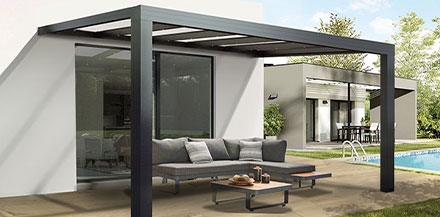
 Carports
 Our price guides
 Kit Verandas
 Entry Airlock

 Awnings & Covers
 Glass Curtains
 Skylight
 Who are we?
 Free delivery
 Secure payment
 My custom quote
 Confirm my order
 Our customer projects
 Our price guides
 Our blog articles
 Installation guides
 Your testimonials
 CliKIT on TV
How to choose your pergola: bioclimatic or aluminum
The decision and choice to cover your patio can prove obvious and above all, very simple.
The decision to cover your patio is the simplest one. The next step is to choose which type of pergola will best suit your needs. The choice is complex and legitimate given how wide and varied the existing pergola catalog is. This article will help you decide based on more or less important criteria, which type of pergola will best match your desires and needs.
What is a pergola?
Logically, this is the first question to ask yourself in order to truly identify your needs. A pergola is a structure attached to the wall of a dwelling, such as a house, or sometimes freestanding.
In essence an extension, it provides an additional room and generally creates a link between the inside and outside of a home.
Thanks to various accessories and structural options, the pergola can also adapt perfectly to outdoor conditions by creating a new room. With the option to close it off in some cases, it has many strings to its bow.
What materials is a pergola made of?
On the market, there are pergolas available in several materials. Each pergola of this type logically has its advantages and drawbacks. What are they?
The aluminum pergola
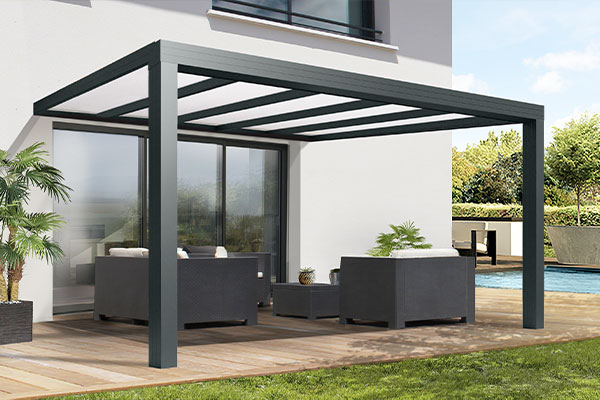
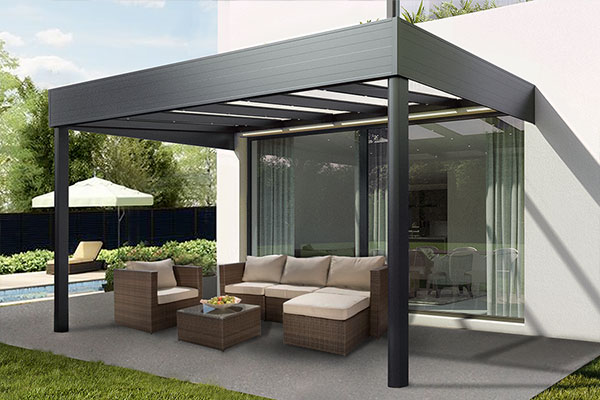
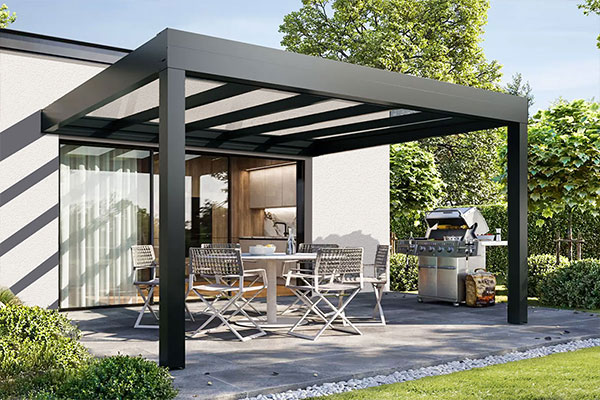
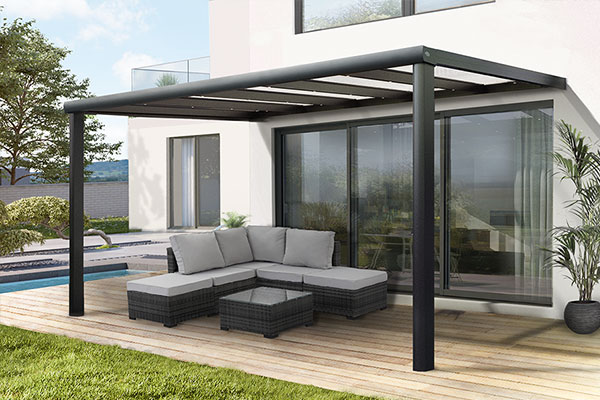
The aluminum pergola is on trend and there are many reasons for this. Clean design, elegant architecture, it suits all types of homes and has an impressively long lifespan, just like those offered by CliKIT. Its resistance to bad weather is also a strength, with a slightly higher cost that is very quickly recouped.
The wooden pergola
The wooden pergola is purely natural and accessible in many respects. Charming, it nevertheless requires fairly significant maintenance every year.
The wrought iron pergola
With a very traditional style, the wrought iron pergola does not fit everywhere but can have its charm in certain homes. Be aware, however, that rust treatment is frequently required.
The steel pergola
Highly robust, the steel pergola is however susceptible to scratches and potential impacts.
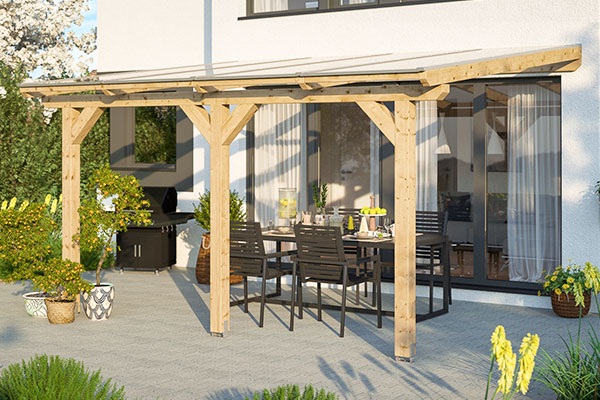
Sun exposure in summer/winter
The climatic criteria and potential adverse weather conditions are so numerous that they must be taken into account when choosing a pergola. Light transmission, temperature, wind resistance, lifespan, aesthetics of materials, airflow, rain noise, etc.: the criteria are telling and sometimes, crucially important for future pergola buyers. They must therefore be considered in the final decision.
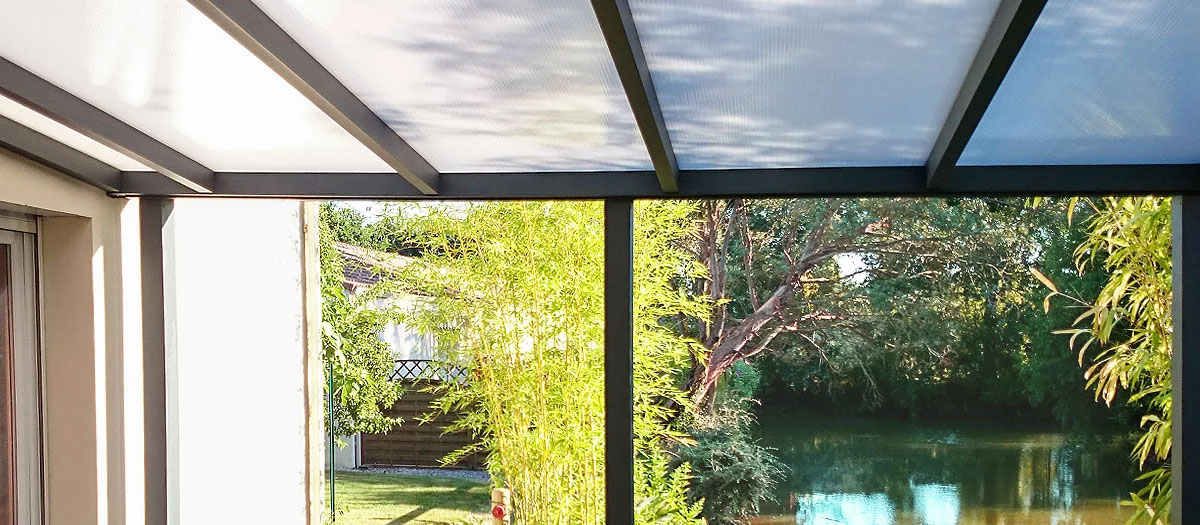
Sun exposure is generally a key deciding factor in being able to enjoy your pergola, and at CliKIT, both types on offer generally satisfy even the most demanding customers.
With an aluminum pergola with a polycarbonate roof
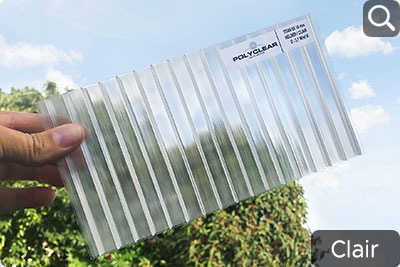
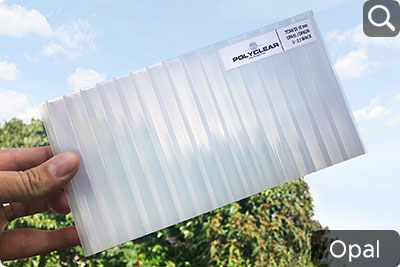
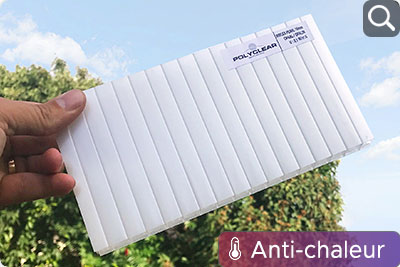
On aluminum pergolas, several polycarbonate tints are used: clear, opal and anti-heat opal, all available in thicknesses of 16mm and 32mm.
The clear tint is preferred for greater clarity and better transparency, and the opal tint for its ability to filter light by reducing the sensation of glare. The anti-heat opal tint is, for its part, recommended for regions with a Mediterranean climate.
In summer and when the sun is very strong, the aluminum patio cover also adapts perfectly with the option to add protection under the roof, such as shade sails, or directly above it with a blind.
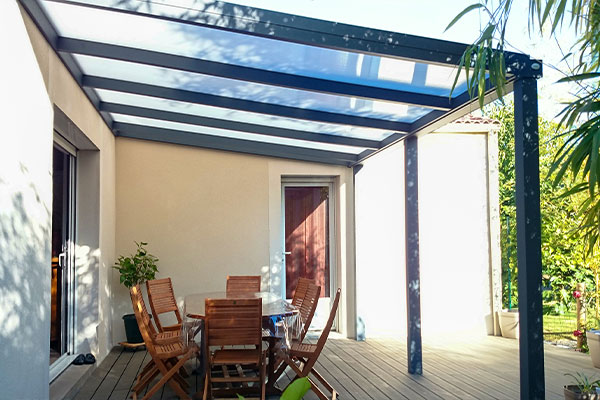
Here are the different tints available depending on your choice of light input:
With a bioclimatic pergola with adjustable slats
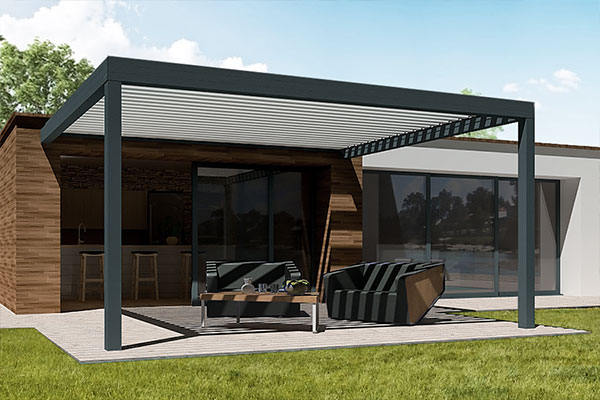
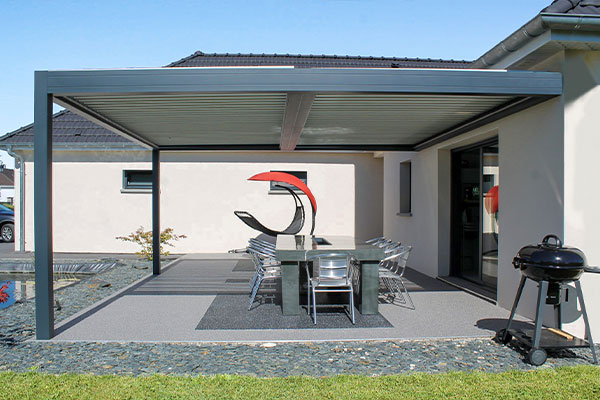
A bioclimatic pergola, on the other hand, works in a completely different way. The supply of light depends on the angle of the slats positioned directly above the structure.
By fully closing the slats, a total shade area is created, which does not reduce the temperature but simply provides a shaded space.
Indeed, by partially or fully closing the slats, you can enjoy your patio while being protected from showers or the sun's rays. Moreover, the presence of these slats gives you the ability to regulate light intensity, as you control the ratio of light you wish to let through. You open and close the slats as you please!
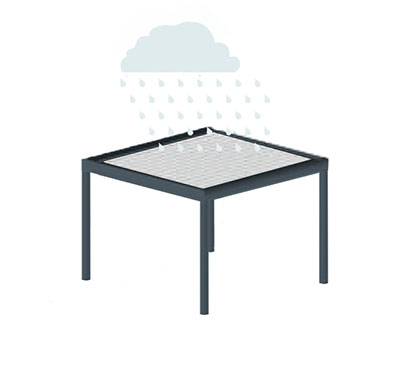 Closed slats to protect against bad weather (rain, snow, etc.)
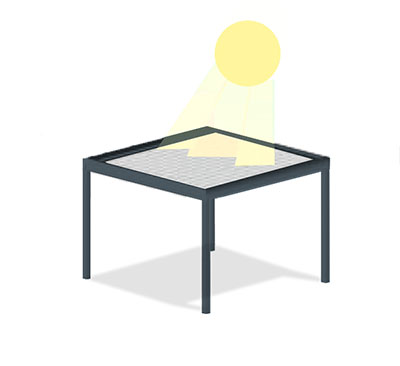 Closed slats to protect against UV rays from the sun
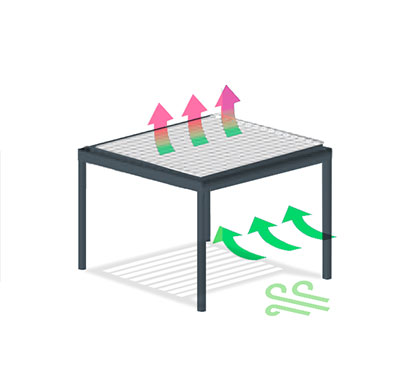 Open slats to enjoy the sun with optimal ventilation
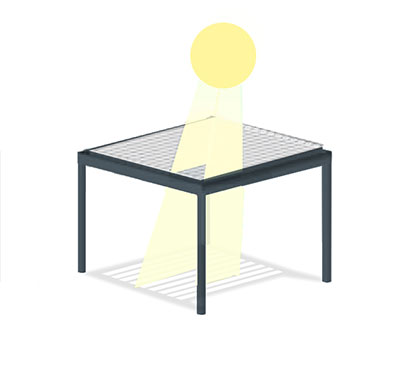 Half-open slats for natural ventilation while regulating light intensity
In conclusion
To choose between a bioclimatic and an aluminum pergola when one of the main criteria is sun exposure and its management, it is necessary to summarize the information listed above.
With permanent light transmission regardless of the season or even the outdoor weather, the aluminum pergola with a rigid roof is the most suitable. Conversely, a shift from full brightness to a significant shaded area is more easily achieved with a bioclimatic model.
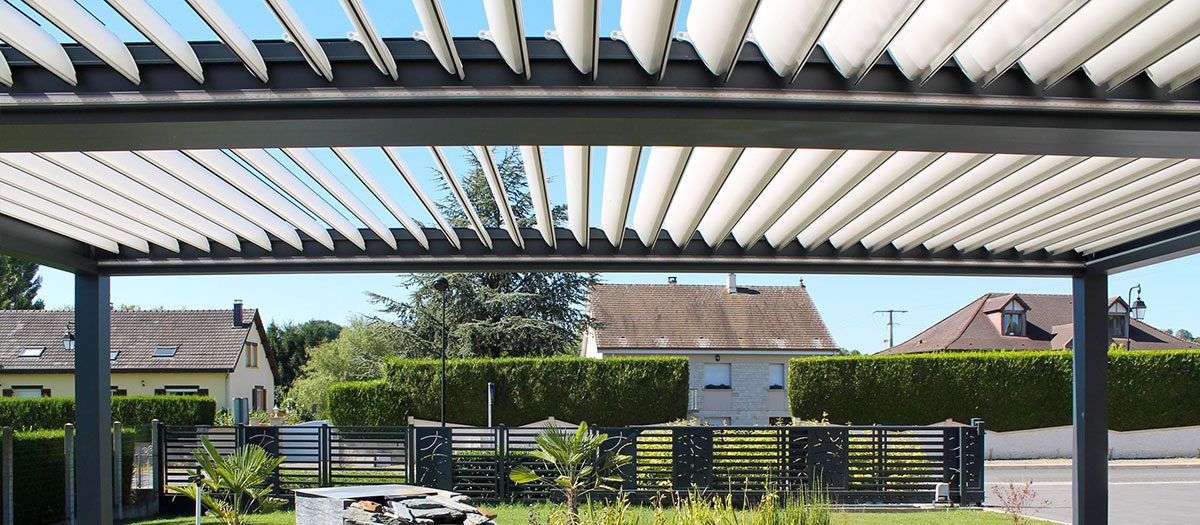
Heat and airflow
Another selection criterion is the heat and air inside the pergola to ensure seasonal or year-round use. Since heat comes from above, the protection to be put in place must necessarily be provided by the roof.
Aluminum is an excellent thermal conductor and with a bioclimatic pergola equipped with such a material, heat will be perfectly redistributed.
Still with a bioclimatic pergola, the opening of the slats allows better air circulation thanks to the vertical ground effect of the wind. In this case, and always depending on your needs from your pergola, it is advisable to control the opening of the slats to also manage the shaded area mentioned above.
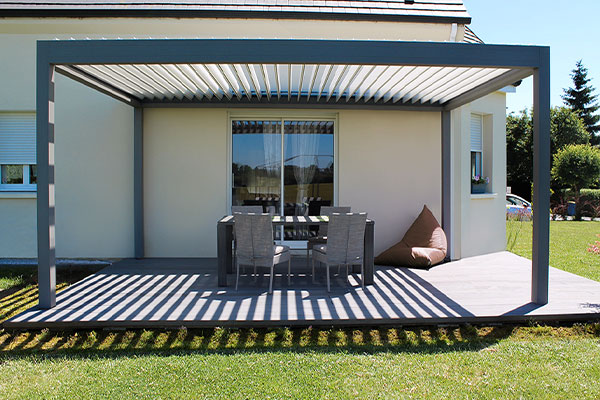
For heat and airflow, the roof of the aluminum pergola is sufficient on its own, thanks in particular to the solar protection of the panels on the structure, which are equipped with anti-UV characteristics and sometimes anti-heat properties.
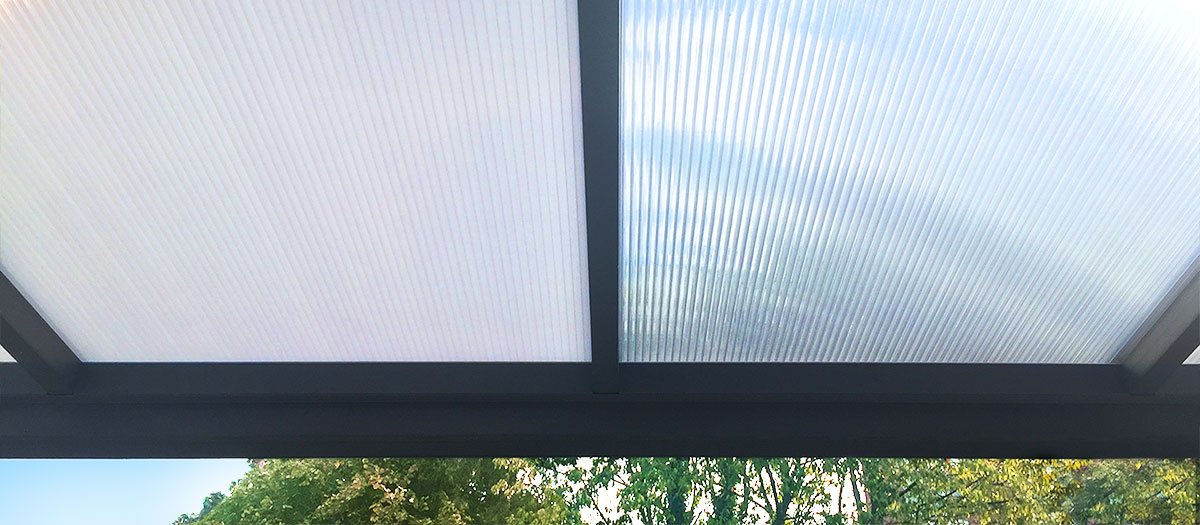
Logically, air circulation can only take place through the open sides of the pergola since the roof is completely closed. Note that depending on the thickness of the polycarbonate panels (16 or 32mm), the protection is slightly different and not without a certain logic.
Aesthetics and design
There is something for everyone, and it is largely for this reason that several types of pergola may suit homeowners to a greater or lesser degree depending on their aesthetic preferences.
With aluminum at the heart of both main types of CliKIT pergolas, this material will inevitably be an integral part of your structure.
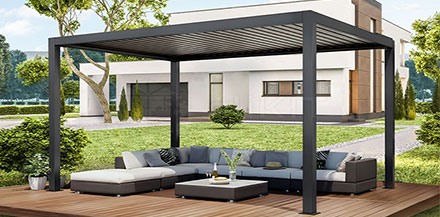
Regarding the bioclimatic pergola, whether lean-to or freestanding, its slightly more square shape with its sharp angles and flat roof go hand in hand with modern architecture. The modernity of the product is further accentuated by the motors, the hinges, and the movement of the slats.
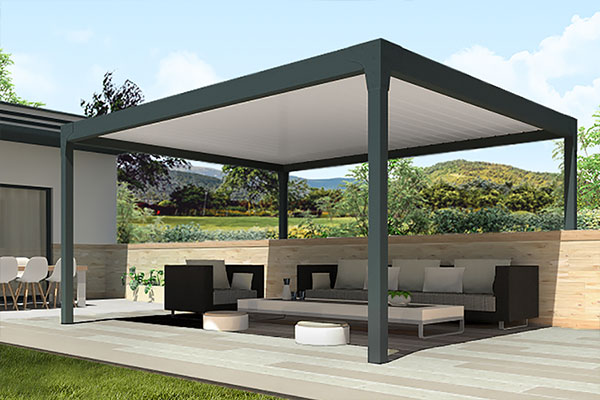
With a cleaner, rounded profile and a roof with an adjustable pitch of 5 and 10°, the aluminum pergola integrates just as well on traditional as on modern homes. It offers a more modular design to fit perfectly into the space, particularly with L-shaped homes or roofs of two different depths.
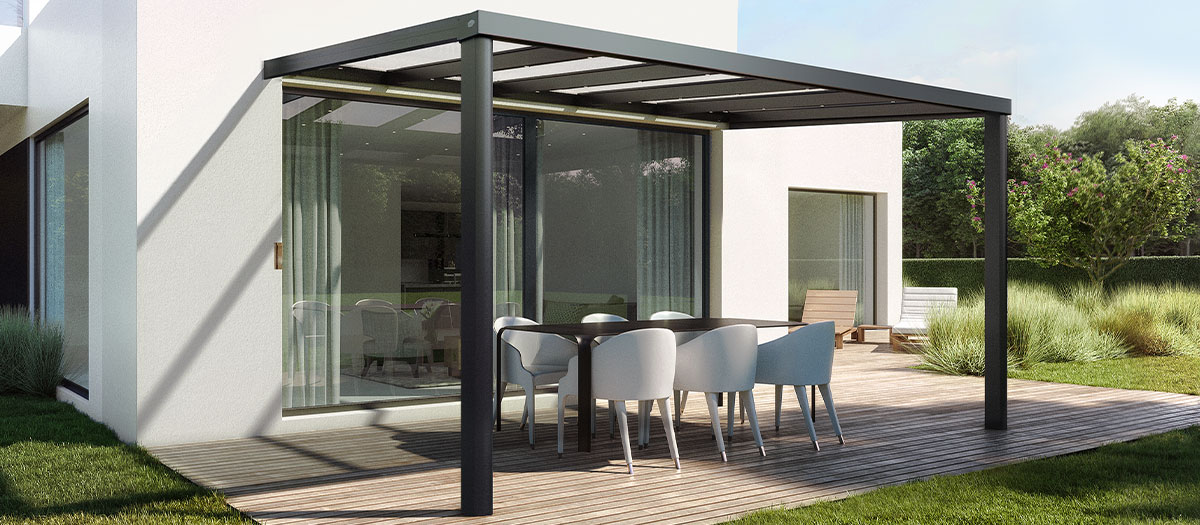
It goes without saying that all of our pergolas can be enhanced with lighting systems and fixed or sliding panels to make this space even more functional, halfway between the inside and outside of your home.
Remember, whatever your choice, a pergola always adds a personalized touch and added value to your home.
Wind resistance
As its name suggests, the bioclimatic pergola is designed to adapt to all weather conditions and even to all seasons when panels are added to it. Wind resistance can therefore be managed, in particular by adjusting the opening of the slats accordingly.
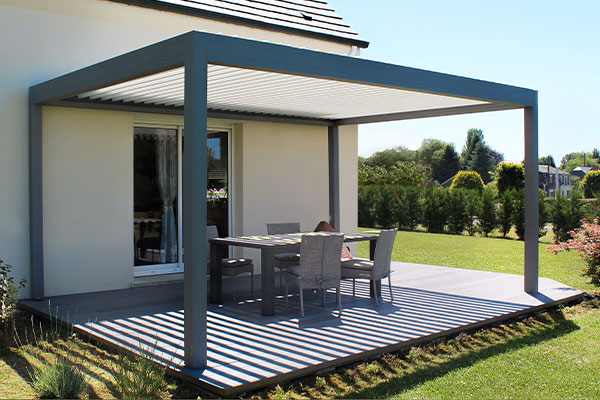
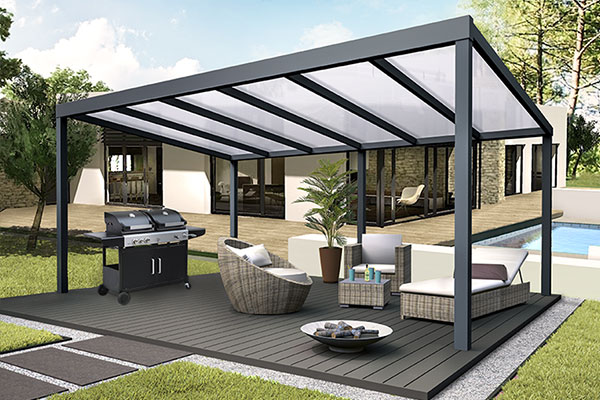
For aluminum-roofed pergolas, the structure is equally solid but airflow management cannot be done through the roof as just mentioned. As for resistance to pure wind and other adverse weather conditions, there is no need to panic! The pergolas and the materials used are of high quality and designed to withstand powerful gusts.
Lifespan and acoustics
Both types of pergola sold by CliKIT are built on an aluminum base. Known for being extremely robust and reliable over time, particularly because it does not rust, aluminum gives the pergola an exceptionally long lifespan.
Both types of pergola therefore share the same advantage. To extend the lifespan of your pergola, it is advisable to clean it properly once or twice a year.
Furthermore, sounds are dampened inside pergolas when they are enclosed with accessories, glass curtains, blinds and panels. Remember, whatever your choice, a pergola always adds a personalized touch and added value to your home.
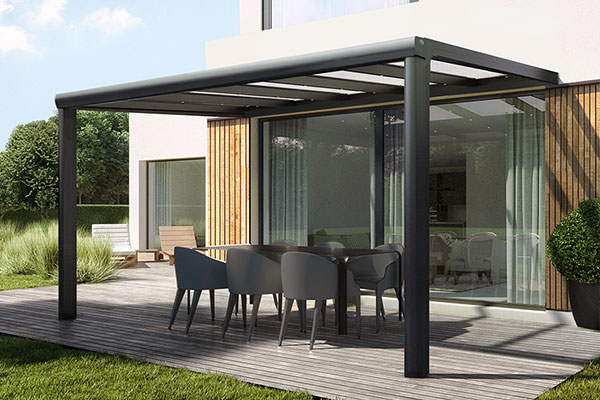
Discover all the accessories to upgrade your pergola!
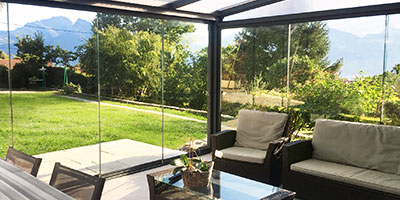 Glass Curtains
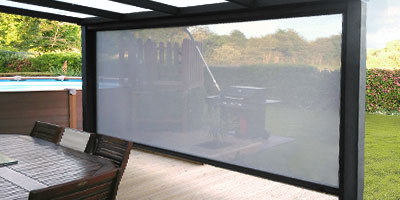 Blinds & Shade Sails
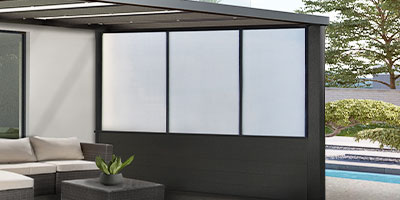 Lateral Panels
Price and cost
With greater modularity, the price of bioclimatic pergolas can, depending on the model chosen and options selected, prove more expensive than a standard aluminum pergola.
The entry-level price for aluminum pergolas is generally around €200 per m², all taxes included, while bioclimatic pergolas start from €400 per m².
In addition to the financial aspect, you now have all the cards in your hand to make your choice between a bioclimatic or aluminum pergola.
Be aware that you can save up to 50% of the final price by assembling your pergola yourself.
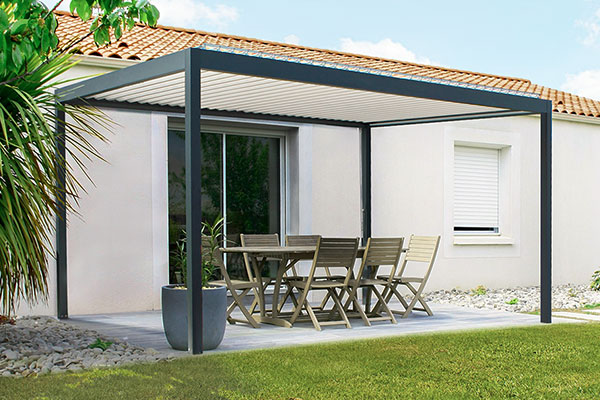
What dimensions should my pergola be?
On the market, there are a large number of pergolas available with dimensions that can vary twofold. However, few companies truly offer the creation of custom-made pergolas, with dimensions perfectly tailored to the needs of the space.
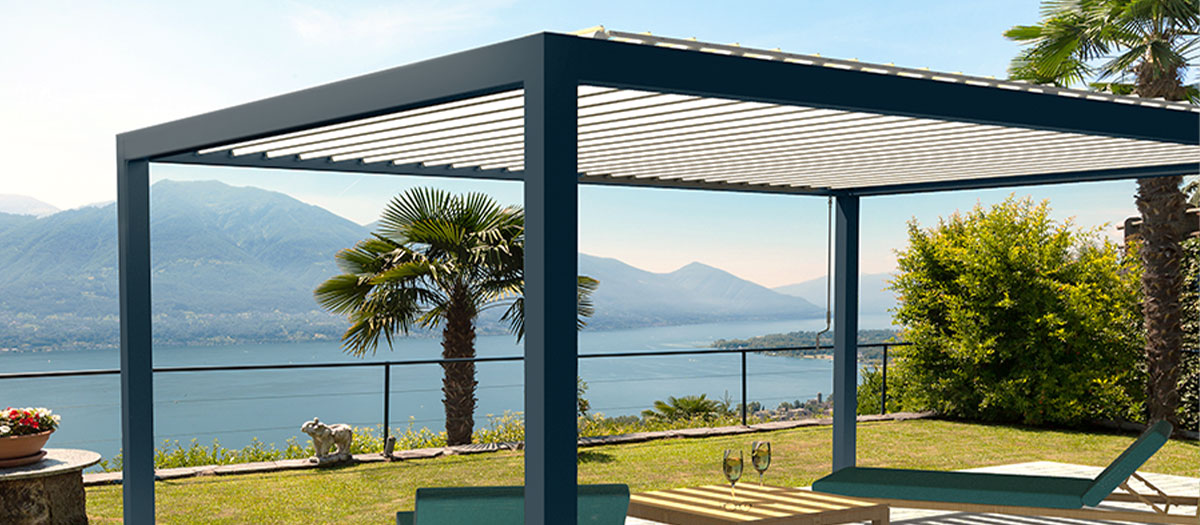
CliKIT offers its pergolas in this way to ensure the perfect installation of this extension in your home. These are not, however, the only advantages offered by CliKIT…
Why choose a kit pergola?
In addition to offering custom-made pergolas, CliKIT also offers kit-assembly pergolas that do not require a large construction project.
A rare and particularly fortunate thing in the world of pergolas, where generally the price rises as soon as the installation requires complex operations.
With a kit pergola, you benefit from rare quality and ease of assembly, without compromising the quality of the product.
Share this content

 View profile